
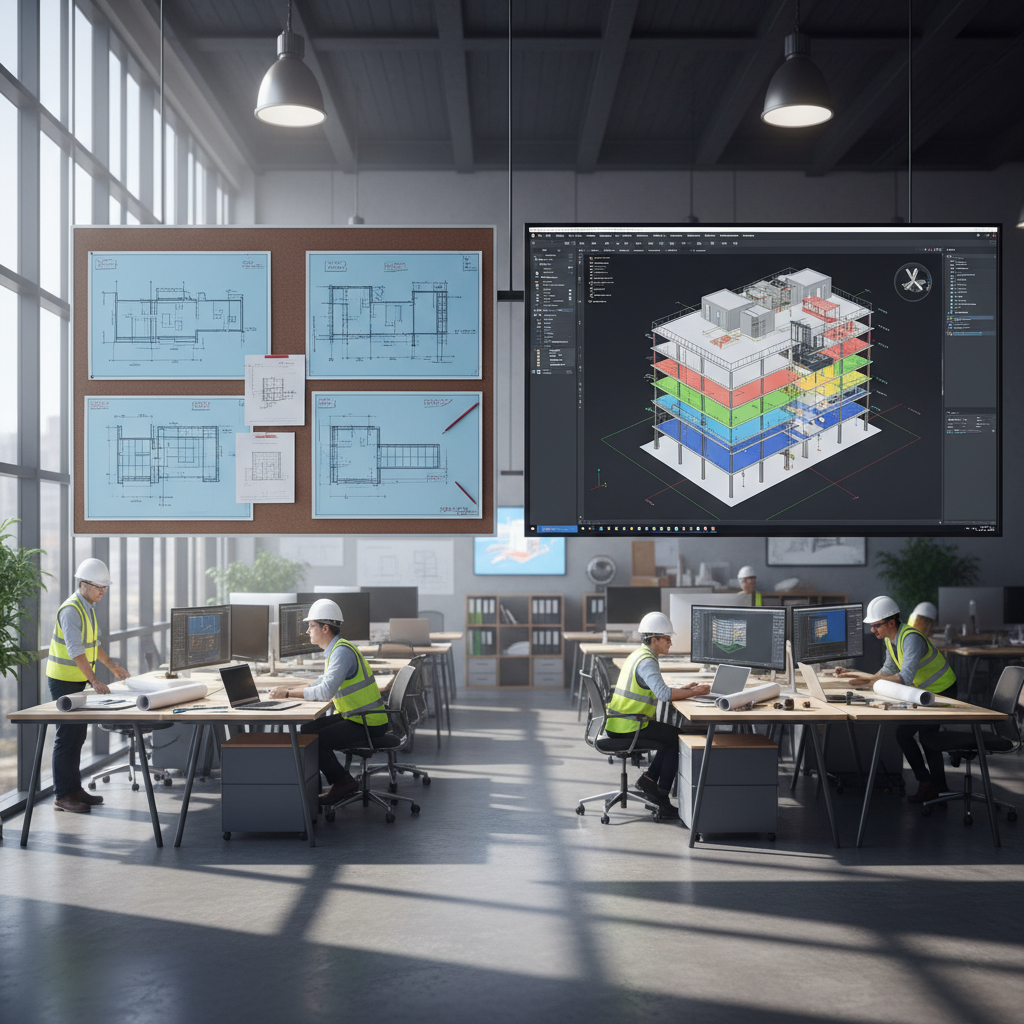
The Evolution of Structural Design in the Digital Age
Structural engineering has undergone a remarkable transformation from manual drafting techniques to sophisticated digital modeling systems. This shift represents not just a change in tools but a fundamental reimagining of how buildings are conceived, designed, and constructed.
Key Highlights
Here are the essential aspects of structural design’s digital evolution:
- Building Information Modeling (BIM) has replaced traditional 2D drafting as the industry standard for structural design
- Modern structural analysis software enables faster calculations and more accurate stress modeling
- Digital collaboration tools allow real-time coordination between engineers, architects, and contractors
- Parametric design capabilities let engineers quickly evaluate multiple structural solutions
- Mobile technologies now bring digital models directly to construction sites
From Paper to Pixels: The Early Digital Transition

The journey from traditional drafting to digital design began in the 1980s with the introduction of Computer-Aided Design (CAD) systems. Prior to this revolution, structural engineers relied on hand calculations and manually drafted blueprints—a process that was both time-consuming and prone to errors. Early CAD programs allowed engineers to create 2D drawings with greater precision and efficiency, though they still essentially replicated the paper-based workflow in a digital format.
By the 1990s, the first 3D modeling tools emerged, allowing engineers to visualize structures with greater clarity before construction began. These early 3D tools represented a significant advancement but still operated largely in isolation from other design disciplines. The real breakthrough came with the development of Building Information Modeling (BIM), which began to gain traction in the early 2000s as computing power increased and software capabilities expanded to handle more complex data relationships.
The BIM Revolution in Structural Engineering
The adoption of Building Information Modeling represents the most significant leap forward in structural design methodology. Unlike earlier CAD systems that simply created drawings, BIM generates a comprehensive digital twin of the building—a data-rich model containing information about every structural element. This approach allows engineers to understand how each component interacts within the overall system, leading to more integrated design decisions.
Modern BIM platforms enable structural engineers to embed critical information such as material properties, load calculations, and connection details directly into the model. This integration creates a single source of truth for the project team and eliminates many of the coordination issues that plagued earlier design methods. According to the UK BIM Framework, projects using mature BIM processes have shown up to 20% reduction in design conflicts and associated rework during construction phases.
Analytical Power: Modern Structural Calculation Software

Behind the visual elements of digital structural design lies sophisticated calculation software that has transformed how engineers analyze building performance. Today’s analysis programs can simulate complex loading scenarios in seconds that would have taken days or weeks to calculate manually. This computational power allows engineers to evaluate more design options and optimize structures for both safety and economy.
Finite Element Analysis (FEA) software has become particularly important in modern structural engineering practice. These programs divide complex structures into thousands of small elements and calculate how each responds to loads, providing unprecedented insight into structural behavior. The Institution of Structural Engineers notes that this approach enables more accurate modeling of unusual geometries and dynamic forces such as wind loads and seismic events—critical capabilities for designing increasingly ambitious contemporary architecture.
Parametric Design and Generative Engineering
The latest evolution in digital structural design involves parametric modeling—a technique that uses algorithms to generate and modify designs based on defined parameters and relationships. This approach allows engineers to quickly explore multiple structural configurations by adjusting key variables rather than redrawing the entire model. The result is a more thorough exploration of design options and often more efficient structural solutions.
Advanced parametric tools now incorporate artificial intelligence to suggest optimizations based on specific project goals such as minimizing material usage or maximizing structural performance. These AI-assisted design systems can analyze thousands of potential solutions and learn from each iteration to suggest increasingly refined options. While these tools don’t replace engineering judgment, they significantly expand what’s possible in structural design and often identify innovative solutions that might otherwise be overlooked.
Digital Collaboration and Project Delivery

The digital transformation has fundamentally changed how structural engineers collaborate with architects, contractors, and clients. Cloud-based BIM platforms now allow real-time collaboration between team members regardless of their physical location. This connected approach means that changes to the structural design are immediately visible to all stakeholders, reducing coordination errors and speeding up decision-making processes.
Digital tools have also transformed how structural information reaches the construction site. Mobile applications now bring BIM models directly to tablets and smartphones used by site personnel, allowing them to access the latest structural details, verify dimensions, and report issues back to the design team. According to research by McKinsey, construction projects using these integrated digital delivery methods show productivity improvements of up to 15% and significant reductions in costly on-site modifications.
Future Horizons: Digital Fabrication and Smart Structures
The next frontier in structural engineering’s digital journey connects design directly to fabrication. Advanced manufacturing techniques such as robotic construction and 3D printing are beginning to produce structural elements directly from digital models without traditional shop drawings or manual interpretation. This direct digital-to-physical workflow reduces errors and opens new possibilities for structural forms that would be impractical to build using conventional methods.
Looking further ahead, structural engineers are beginning to incorporate sensors and smart materials into their digital models, designing buildings that can monitor their own condition and adapt to changing environments. These intelligent structures represent a new paradigm where the digital model doesn’t end when construction is complete but continues to evolve throughout the building’s lifecycle. The UK’s Construction Innovation Hub predicts that by 2030, most major infrastructure will incorporate these smart capabilities, creating buildings that are safer, more efficient, and more responsive to user needs.
The Future of Structural Design in a Digital World
The transition from paper blueprints to comprehensive digital models has fundamentally changed both what structural engineers can create and how they work. This evolution continues to accelerate as computing power increases and software capabilities expand. The most successful structural engineering practices today are those that have embraced these digital tools while maintaining the fundamental engineering principles that ensure building safety and performance.
Sources
Institution of Structural Engineers Digital Engineering Resources