

Designing for Vibration Control in Commercial Floors
Vibration control is a critical aspect of commercial floor design that directly impacts occupant comfort and building functionality. Effective vibration management requires careful structural engineering to prevent unwanted movement that can affect sensitive equipment, cause discomfort to occupants, or compromise the building’s performance over time.
Key Highlights
Here are the essential factors in designing commercial floors with effective vibration control:
- Response factors vary by building use: offices typically require 8Hz, while hospitals may need 4Hz minimum natural frequencies
- Floor span and structural depth have inverse relationships with vibration performance
- Composite steel-concrete solutions offer excellent vibration control for medium to long spans
- Post-tensioned concrete provides superior vibration damping for sensitive environments
- Early-stage vibration analysis can prevent costly retrofits and operational disruptions
Understanding Vibration Sources in Commercial Buildings

Commercial floor vibrations typically originate from two primary sources: human activities and mechanical systems. Walking, running, jumping, and even dancing generate rhythmic forces that can resonate with a floor’s natural frequency, while HVAC equipment, elevators, and other building systems produce mechanical vibrations that transfer through the structure. Each commercial building type has different sensitivity requirements based on its use—laboratories and hospitals requiring the strictest controls, followed by offices with computer equipment, and retail spaces generally having the most forgiving standards.
The vibration response factor is measured on a scale that correlates with human perception, with lower numbers indicating better performance. For standard offices, a response factor of 8 is typically acceptable, while hospitals and research facilities often require factors as low as 2-4 to maintain operational precision. According to the Concrete Centre, designing to these specifications from the beginning can save up to 15% on structural costs compared to retrofitting solutions later, making early vibration planning an essential economic consideration for commercial developments.
Floor Structure Selection for Vibration Performance
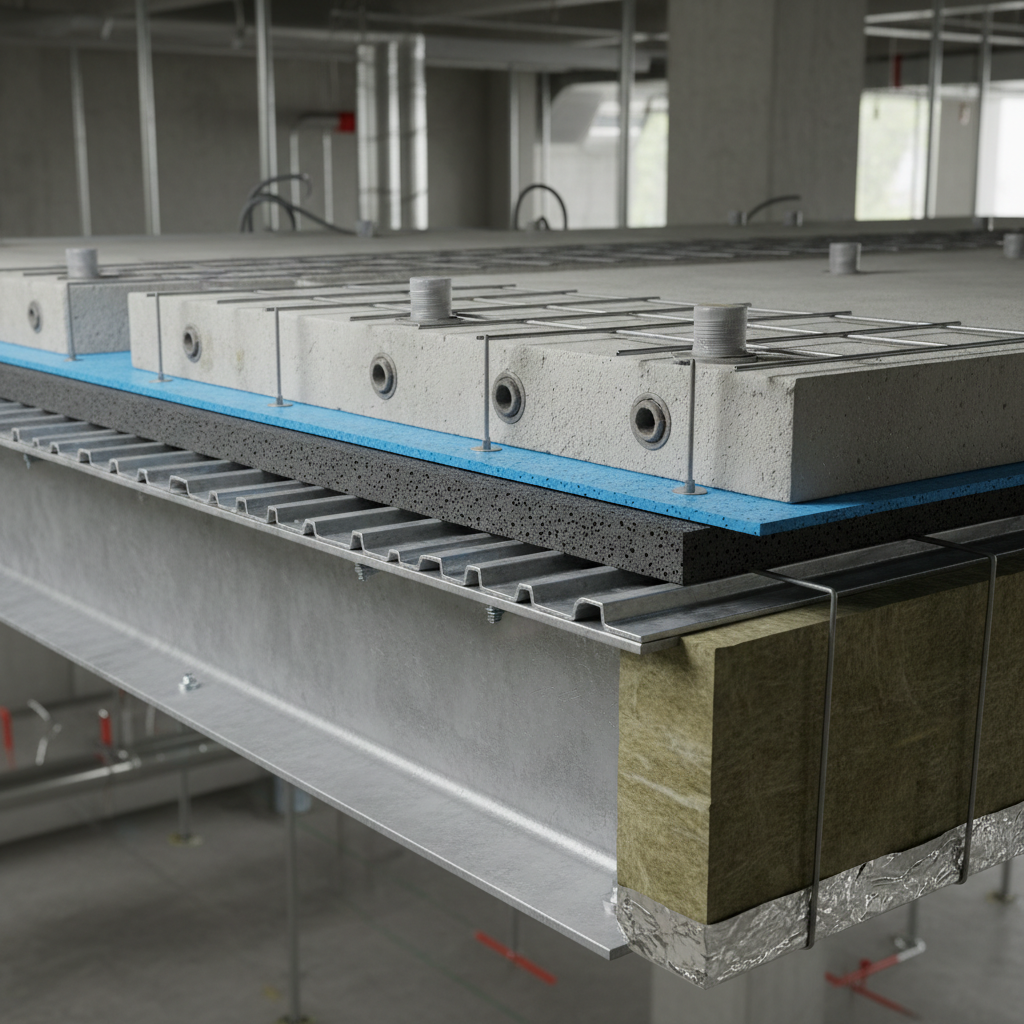
The choice between structural systems fundamentally affects a commercial floor’s vibration characteristics. Concrete floors, particularly post-tensioned slabs, provide significant mass and stiffness that naturally dampen vibrations and are ideal for facilities with sensitive equipment. Alternatively, composite steel-concrete solutions offer excellent vibration control while maintaining lighter overall building weight and allowing longer spans between columns.
For buildings requiring flexible layouts, long-span structural solutions must balance open-plan requirements with vibration control. Steel beams with concrete topping can achieve spans of 15 meters while maintaining acceptable vibration characteristics when properly designed with sufficient depth and stiffening elements. The relationship between span and depth becomes particularly critical—increasing a floor’s structural depth by just 100mm can improve vibration performance by up to 30%, a principle that directly influences early design decisions.
Frequency Analysis and Modal Behaviour
The natural frequency of a commercial floor system determines its susceptibility to resonance with walking-induced vibrations. Most human walking activity generates forces in the 1.8-2.2Hz range, making floors with natural frequencies below 4.5Hz particularly vulnerable to amplified vibration. Engineers use finite element modeling (FEM) to predict these modal responses and identify potential problem areas before construction begins.
Computational analysis reveals not just the frequency but also the mode shapes—the specific patterns in which a floor will deflect when excited. Modern software can simulate these responses under various loading conditions, allowing engineers to identify and address potential vibration issues during the design phase. The Institution of Structural Engineers guidelines recommend maintaining a minimum natural frequency of 4Hz for standard office floors, with higher frequencies (6Hz or above) for spaces with sensitive equipment or where vibration perception would be particularly problematic.
Practical Implementation of Damping Measures

When designing for vibration control in commercial floors, engineers implement multiple damping strategies to achieve the required performance. Increasing the floor’s mass is the most straightforward approach, as heavier floors naturally resist motion and dissipate energy more effectively. Strategic placement of non-structural partitions perpendicular to the main span direction can provide additional damping, reducing vibration amplitude by up to 40% according to studies by the Steel Construction Institute.
For existing buildings with vibration issues, retrofit solutions range from adding mass through additional concrete toppings to installing tuned mass dampers that counteract problem frequencies. These devices, often weighing several hundred kilograms, are precisely calibrated to oscillate out of phase with the floor’s vibration, effectively canceling the motion. The cost of retrofitting can be substantial—often 5-10 times more expensive than incorporating proper vibration control during initial design—highlighting the importance of comprehensive vibration analysis during the planning stage.
Verification and Performance Testing
After construction, engineers verify vibration performance through specialized testing procedures that measure the floor’s actual behavior under controlled conditions. These tests involve inducing controlled vibrations and measuring the response using accelerometers placed at strategic locations. Results are compared against predicted values from the design models to confirm compliance with the specified performance criteria.
Long-term monitoring systems can also be installed in particularly sensitive facilities to provide continuous feedback on floor performance. These systems alert facility managers to any changes in vibration characteristics that might indicate structural issues or the need for adjustments. For multi-use commercial buildings, different zones may have varying vibration requirements, requiring a holistic approach to floor design that balances performance needs with construction efficiency and cost considerations.
Conclusion
Effective vibration control in commercial floors requires a balanced approach that considers building use, structural system selection, and economic constraints. By addressing vibration concerns during the initial design phase, engineers can deliver comfortable, functional spaces that meet the specific needs of commercial clients without requiring costly modifications later. The science of vibration control continues to advance, offering increasingly sophisticated tools for predicting and managing floor performance in commercial buildings.